
An eight-step service process, one diagnostic methodology, and a set of workmanship standards and acceptance criteria held on every site - turning thirty years of field experience into working rules that can be supervised and replicated.
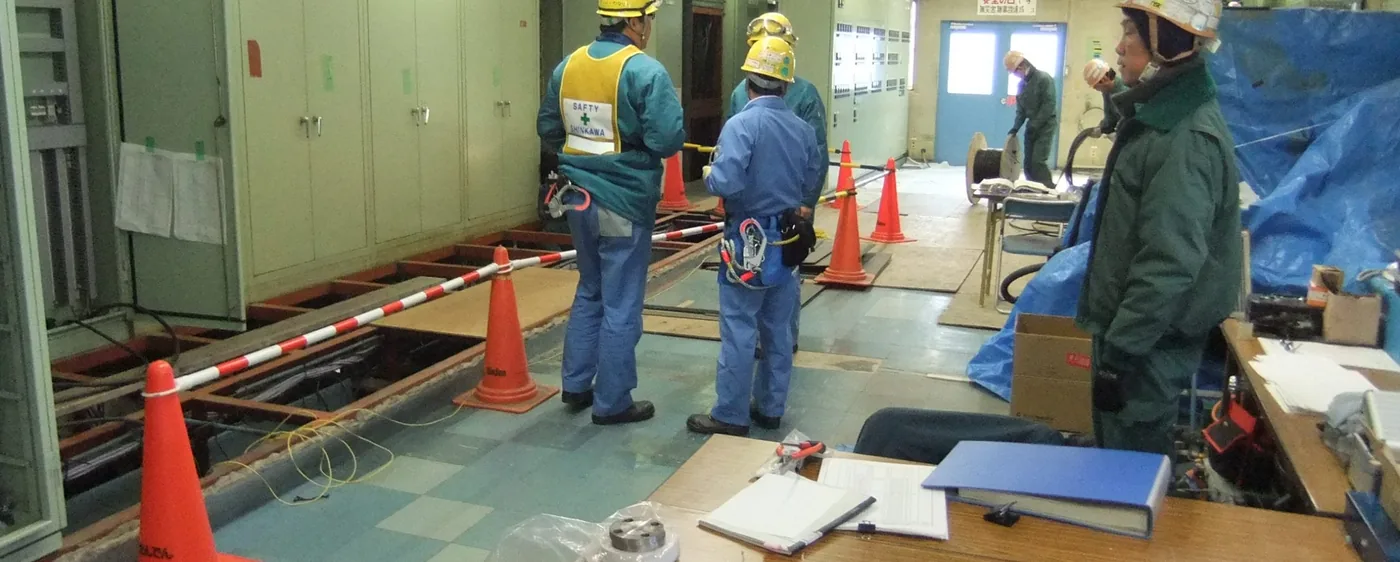 DIAGNOSIS FLOW · SCHH-2026
From site survey to follow-up visit, every step has defined actions and deliverables, so customers can hold us to account against it.
Collect the data on site: current, temperature, vibration, cycle time and downtime records all at once. Facts first, judgement second.
Locate the root cause with the three-step method and the mechanical/electrical split, distinguish intermittent from degradation-type faults, and issue a diagnostic conclusion.
The remedy, schedule, cost and acceptance criteria are explained once and clearly, with a repair/modify/replace economic comparison.
Align the downtime window with the production plan, stage parts and tools in advance, and never let the equipment wait for people.
Clearances, torques and alignment data are recorded item by item and signed off by both parties; no record, no next step.
No-load checks for noise, temperature rise and vibration; load checks on the output curve; accuracy re-measured against factory standards and process requirements.
Drawings, inspection sheets, baseline data and lubrication cards go into the file; handover is only complete once operators have passed their assessment.
Three months of follow-up confirms no recurrence; operating data feeds back into the maintenance strategy so the plan evolves with the equipment.
A fault will not tell you what is wrong, but the data will. These are the analysis paths we hold to when we lead the attack.
 FIELD · SCHH-2026
The standards below are the technical basis for our work and acceptance (always the currently effective version applies).
Acceptance is not a formality — it is confirmation against data. These five rules are hard constraints we impose on ourselves.
Agree the criteria up front and nobody argues later.
Three layers: no-load checks for abnormal noise, temperature rise and vibration; loaded checks for output curves and cycle time; then precision re-measured against factory standards and process requirements. Every figure is recorded and signed by both sides — incomplete records do not count as delivery.
We do the arithmetic: residual value, downtime losses, retrofit and replacement costs all folded into one table, with three options and their payback periods. The plant makes the call. We never push the most expensive option — only the one whose numbers add up.
Run-to-failure is firefighting — the fault decides when you stop. Preventive maintenance schedules inspection, lubrication and calibration from equipment condition and fault history, so failures land inside planned shutdown windows. Plants that keep it up for three months typically cut unplanned downtime by more than half.
Equipment shipped by out-of-province suppliers into Sichuan plants we install and commission on site. For existing plants in Yunnan, Guizhou and Chongqing our Nanchong-based engineers travel on schedule — same process, same records, same acceptance criteria as at home base.
The methodology answers 'how to think'; the workmanship standards answer 'how to do'. These eight are hard requirements executed on every job we enter - never discounted for a tight schedule or a pressing customer.
In our field experience a considerable share of bearing, chain, gear and hydraulic failures trace back to lubrication: not a lack of lubricant, but the wrong lubricant, too much of it, or too late. Good lubrication management saves a great deal of overhaul money.
Temperature range, load character, speed, dust and moisture levels, and the presence of corrosive media - each of these affects the lubricant choice. The hot, dusty duty of a feed or biomass pellet plant and the damp, corrosive duty of a wastewater plant follow completely different lubrication logic. Copying the manufacturer's generic recommendation often fails under special duty conditions.
Too much grease generates churning heat and temperature rise, extrudes seals into failure, and traps old grease carrying wear particles with no way out. We calculate the quantity from bearing type and speed, judge it by old grease purging or the level mark, and write the quantity onto the lubrication card so the team follows a figure rather than a feel.
The same fan may need oil changes three times as often in a dusty shop as in a clean one. We set intervals from site duty and oil sample condition, then correct them with measured data after a period of running - turning intervals from 'copied' into 'calculated'.
Most hydraulic failures relate to fluid contamination. Cleanliness is judged to ISO 4406, and the grade decides filtration, oil change or flushing; getting the details right - fill ports, breathers, element changes - is more effective than switching to an expensive oil.
One card per lubrication point: grade, quantity, interval, last execution date, executor, abnormalities. Cards travel with the equipment file, so no information is lost when people change. A checklist full of ticks that still catches nothing on site usually fails because it carries no decidable values.
We hand the greasing method, the criteria and the common mistakes over to the operating and maintenance staff - how to read an oil level, how to tell whether grease has degraded, what signs call for a repair request. When people leave and the standard stays, lubrication management has truly landed.
Related field records can be found in our technical experience and case reports: 'A lubrication revolution on a biomass pellet line: ring die bearing life from 40 days to 9 months' and 'Wastewater plant aeration blower maintenance: rebuilding lubricants and intervals for corrosive duty'.
The process and acceptance have been covered above; here are some more specific questions - most of them actually asked by plants we have worked with.
Instruments collect the data; experience interprets it. Vibration analysers, infrared thermometers, insulation testers and laser alignment systems travel with the team, and we measure before we judge. What experience contributes is knowing where to measure, what the data means and what to check next. We do not draw conclusions from sound alone: abnormal noise goes to a spectrum, not to a hunch - bearing characteristic frequencies do not lie.
For a fault that is intermittent and unrecorded, the first step is to let it leave its own evidence: fit data capture to log error counts, voltage fluctuation, scan cycle, temperature curves and action sequence, then wait for it to strike again. These problems cannot be rushed, but once the data is in hand the fault is usually located faster than expected. We have a case on record where seven days of continuous monitoring ended with the cause traced to a single shield layer.
Complete the drawings before starting work. We survey the electrical circuits on site, verify terminals and components, and fill in the mechanical reference data (clearances, fits, travels, torques) to form the equipment file. The survey is itself an inspection - many hidden defects are found during it. At handover the drawings and the file are delivered together, so later maintenance is never groping in the dark.
Put the effort in before the shutdown. Survey, diagnosis, planning, spare parts and tooling preparation are all brought forward, so only work that truly requires the machine down happens inside the window; key data is recorded on prefabricated forms that take no time to fill in on site. A tight schedule is never a reason to skip acceptance: waiting can be compressed, records and trial runs cannot.
The arithmetic is simple: the loss from one unplanned stoppage (lost production, overtime to catch up, quality scrap, delivery penalties) normally far exceeds a whole year's preventive maintenance spend. We make no vague promises - our method is to pull out your downtime records for the past year and work out by fault type which failures can be prevented, what prevention costs, and how much downtime can be expected to disappear, doing the arithmetic with your own data.
Most need some adjustment, which is why training is counted as part of the delivery. Changes to safety interlocks, alarm prompts and parameter setting must be understood by operating and maintenance staff - why the change was made, how to use it, what signs call for a repair request. Delivery counts only once the operators pass their assessment. A machine upgraded but unusable by its operators is as good as not upgraded.
When replacing is right we say so - but always with the arithmetic. Residual value, failure downtime losses, retrofit investment and replacement investment are reduced to one table, with three options and their payback periods. On a ten-year-old line we once talked the owner into repairing by means of the cost comparison table; on others we recommended replacement. The criterion is payback and reliability requirement, not how much work we would get.
All of it, to you. Overhaul records, test data, drawings and I/O schedules, inspection sheets, lubrication cards and acceptance reports are handed over in one go - a missing item counts as undelivered. The copies we retain are used only to judge continuity in later maintenance, never for other clients and never disclosed outside.
 FIELD · SCHH-2026
 FIELD · SCHH-2026
It starts with one site survey: turn the problem into data, and the data into a plan.
 Scan to add Engineer Man on WeChat
 Guangzhou Yujihang Computer Technology Co., Ltd. · www.accpc.com.cn
 Guangzhou Henghuan Technology Co., Ltd. · www.hhrobotics.cn
 Nanchong Henghuan Robotics Co., Ltd. · www.hhrobots.cn