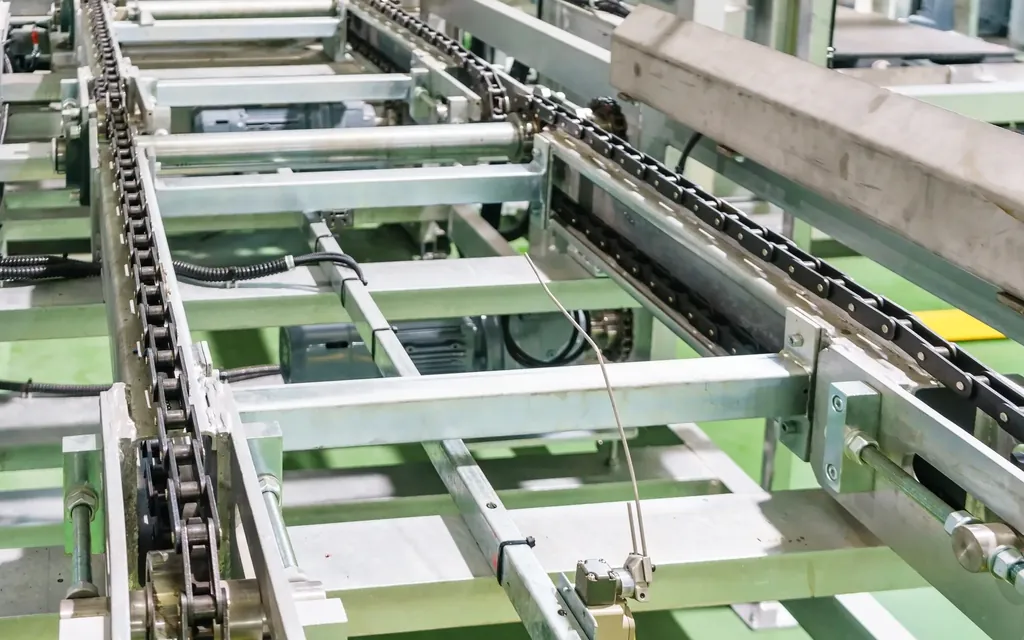
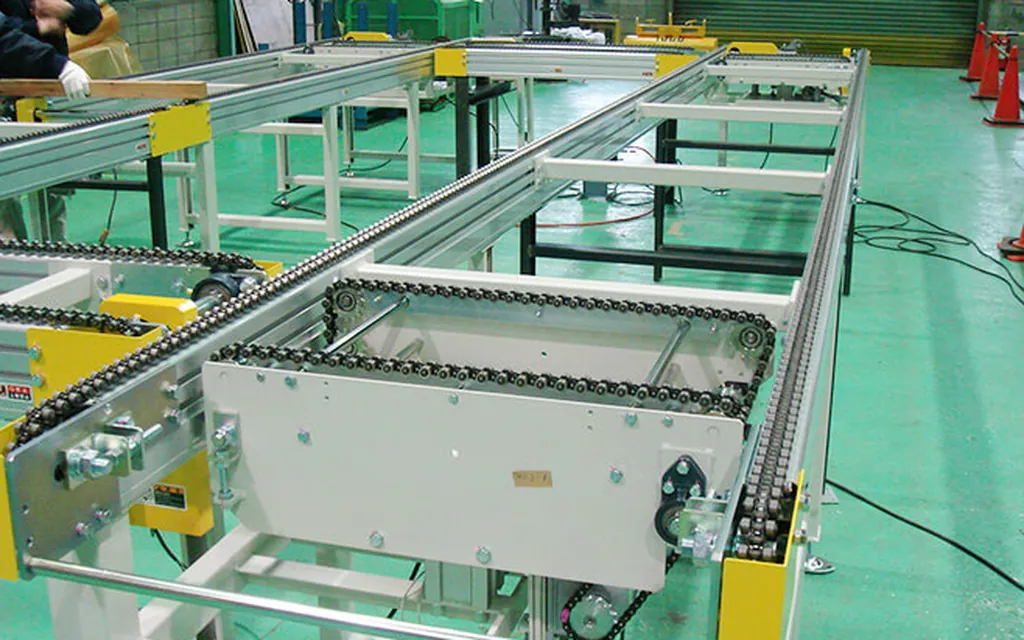
A broken chain is the worst fault on a continuous line: the whole line stops, the repair is slow, and it can smash other equipment. Chain care comes down to two things — do not let it go slack, and do not let it run dry.
Too tight and the pins and bushings wear faster while the drive motor works harder; too loose and the chain skips teeth, rides up, or jams at turns. The right slack: at mid-span you can press the chain down 15–25 mm with your thumb (take the lower figure for heavy-duty chains).
Tensioners come in spring and counterweight types. On spring types check regularly that the spring has not gone solid or broken; on counterweight types check that the weight slides freely — a jammed guide rail silently kills the tensioning, and that is a hidden fault.
On auto-tensioning machines an alarm fires when the tensioner reaches the end of its travel. That alarm means the chain has stretched to the point of needing replacement. Do not force more tension to limp along — you are trading the drive unit and sprockets for time.
 FIELD · SCHH-2026
Chain stretch is the result of pin and bushing wear and cannot be judged by eye. Measure the total length over 10–20 pitches with calipers, divide by the number of pitches to get the actual pitch, and compare with the nominal pitch of a new chain. Replace once elongation exceeds 2% (1.5% for heavy-duty or high-speed chains).
One section is not enough. Measure at three evenly spaced points along the chain and take the highest value. Uneven wear between sections points to local resistance — check the turn tracks and look for wedged material.
Assess the sprockets together with the chain. A new chain on worn sprockets is soon pulled apart again. Once the tooth profile is hooked or tooth thickness is down more than 10%, replace both at the same time.
 FIELD · SCHH-2026
The lubrication point of a chain is between pin and bushing, and the oil has to wick its way in. Smearing the outside is basically useless. Apply oil with a brush or dripper to the pin area on the inside of the chain; applying while it runs works best.
In dusty settings (foundry, building materials, biomass), grease binds with dust into a grinding paste. There, frequent light oil beats a thick smear of grease. Where possible fit an automatic lubricator on a timed, metered cycle.
Check tracks and guide wheels monthly: wear groove depth in the track, whether the guide wheels turn freely, and whether fixing bolts are loose. A locally worn pit in the track shocks the chain as it passes and speeds up pin wear.
| Maintenance item | Interval | Method | Acceptance criteria |
|---|---|---|---|
| Chain tension check | Weekly | Thumb pressure at mid-span | 15–25 mm give (lower figure for heavy duty) |
| Chain elongation measurement | Monthly | Calipers over 10–20 pitches, averaged | Elongation <2% |
| Pin lubrication | Weekly (twice weekly in dusty duty) | Oil applied to the inside of the pins | Runs smoothly, no abnormal noise |
| Sprocket tooth profile check | Quarterly | Visual tooth profile; calipers on tooth thickness | Tooth thickness loss <10% |
| Track and guide wheel check | Monthly | Groove depth, free rotation, bolts | No pits, no looseness |
| Tensioner travel check | Monthly | Travel reserve; spring / counterweight condition | Travel short of the limit; moves freely |
Conveyor chain failure almost never happens abruptly: first the pins and bushings wear and the pitch gradually stretches, then meshing with the sprocket worsens with more tooth-jumping and impact, and finally it parts at some load peak. The whole failure process is progressive, which means that with periodic elongation measurement, replacement timing is entirely plannable. Measuring chain elongation is simple too: take a fixed span (say twenty pitches), measure the total length, compare with the standard value, and replace when the elongation rate reaches the limit (typically 1.5%-3%, depending on chain type).
More important than measuring is building a life register: installation date, every measurement, lubrication records and replacement dates for each chain, all on file. After two or three cycles the register gives you a chain life curve for your own duty - and purchasing plans, spare stock and maintenance scheduling all gain a basis. Without a register, spare purchasing is forever "buy it when it's about to snap": either waiting on parts through a stoppage or carrying dead stock.
Tension management is the other half of chain life. Too slack and meshing impact is heavy, with tooth-jumping and derailment likely; too tight and the pins and bushings are overloaded - wear accelerates and power consumption rises. Adjust tension to the catenary standard (sag is typically 1%-3% of the center distance, per chain specification), and verify automatic tensioners function properly at regular intervals. Lubrication in place, tension right, elongation under control - do these three well and a doubling of chain life is nothing unusual.
By chain type and duty: precision roller chains and conveyor chains are usually recommended for replacement at 1.5%-2% elongation, taking the lower end under heavy duty; for large-pitch conveyor chains some manufacturers allow up to 3%. But there is one rule of thumb - in systems where the drive sprocket is expensive and the chain is cheap, change the chain early rather than let a stretched chain grind the sprocket. Specific limits follow the chain manufacturer's technical documents; write the limit you actually adopt clearly into the register and enforce it plant-wide.
 FIELD · SCHH-2026
Choose by speed and duty: slow, heavy chains (drag-conveyor types) take brush-applied or drip-fed high-viscosity chain oil; medium- and high-speed chains use automatic drip or oil bath; high-temperature duty (drying lines) calls for synthetic chain oil; in heavy dust, mind the oil's tackiness and the sealing arrangement. The key to lubrication is not how expensive the oil is but that it is continuous and complete - an automatic device plus periodic checks is far more reliable than a brush-down whenever someone remembers. Put lubrication condition into the weekly inspection: look at the oil film on the chain surface and for bright dry-friction spots at the pins.
Chain and sprocket are a friction pair whose wear accelerates each other: a stretched chain meshing a worn sprocket concentrates contact on the tooth tips, and both sides wear several times faster than normal. That is why every chain change must include a sprocket check - the step most often skipped in conveyor maintenance. Judge a sprocket on three features: whether the tooth profile has worn hook-shaped (normal teeth are symmetrical; worn ones sharpen and lean in the direction of travel), whether tooth thickness reduction exceeds the limit, and whether the tooth faces show cracks or plastic deformation. Any one feature clearly present, and sprocket and chain are replaced together.
The price of skimping on sprockets can be quantified: new chain on worn sprockets typically lasts half the normal life or less, and tooth-jumping and noise appear quickly. The cost of one sprocket set is usually less than one extra chain replacement plus an emergency shutdown repair. This arithmetic has been verified in every plant that ran worn sprockets - not theoretical deduction, but a pattern that recurs on site.
One more situation deserves attention: when a chain is stretched but below the limit, can just the most heavily worn section be replaced? Usually we advise against it. A chain is a continuous load-bearing member - mixing new and old sections creates pitch mismatch, uneven meshing and load distribution, and stress concentration at the joints. Unless the design explicitly provides for sectional replacement (detachable links, for instance), replacing the whole run is the more reliable choice. The chain money saved by sections gets paid back in joint failures and accelerated sprocket wear.
 FIELD · SCHH-2026
This article was written in-house by the Industrial Equipment Services Division. The thresholds, intervals and scrap criteria are field-experience values; in practice follow the equipment manufacturer's technical documents, current national standards and special-equipment safety regulations. Inspection and testing of special equipment (cranes, pressure vessels, etc.) must be carried out by a qualified body.
Send us your equipment list and operating conditions, and we will give you a workable inspection and maintenance standard.
 Scan to add Engineer Man on WeChat
 Guangzhou Yujihang Computer Technology Co., Ltd. · www.accpc.com.cn
 Guangzhou Henghuan Technology Co., Ltd. · www.hhrobotics.cn
 Nanchong Henghuan Robotics Co., Ltd. · www.hhrobots.cn