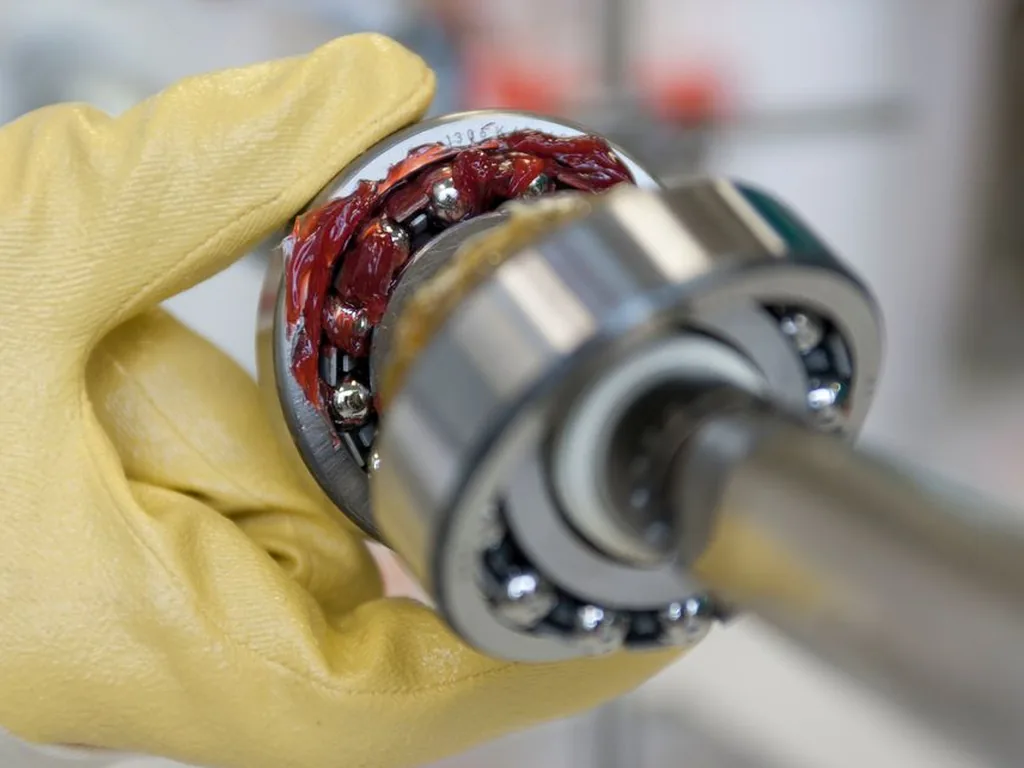
Half of fan vibration problems come from dust build-up on the impeller upsetting the balance, and half from the bearings. Both have straightforward daily care routines — the point is not to wait until the vibration is already bad.
Fans handling dusty gas collect uneven deposits on the impeller. Once enough builds up, a chunk lets go, balance is destroyed in an instant, and vibration spikes. This is very common on boiler induced-draught fans, dust-extraction fans and wood-chip fans.
Prevention: clean the impeller regularly (monthly to quarterly depending on dust concentration) and log vibration before and after each cleaning; add anti-build-up features (such as a dust-shedding disc) on the non-working faces; where possible fit an on-line water spray cleaning system.
To tell build-up from a bearing problem, look at vibration direction: build-up shows mainly radial (horizontal) vibration that creeps up with the deposit and then changes abruptly; a bearing fault shows clearly at the housing, with characteristic frequencies in the spectrum.
 FIELD · SCHH-2026
Fan bearings usually run harsher than pump bearings: higher temperature, axial thrust, relatively low speed. Use a high-temperature grease (dropping point above 200 °C) — ordinary lithium grease will not do.
Grease quantity: one third to one half of the cavity volume — less is better than more. Overfilled grease churns in the cavity, temperature rises, the grease thins and leaks away, and then more gets added: a vicious circle.
On oil-bath housings keep the level at the sight-glass centre. Shorten oil change intervals for hot duty; change the oil when it darkens or smells burnt.
Log housing temperature monthly. Above 80 °C, investigate: over-lubrication, blocked cooling water, misalignment, or a bearing at the end of its life.
 FIELD · SCHH-2026
Re-check fan-to-motor alignment every six months. On belt-driven fans check belt tension and pulley alignment: over-tensioned belts raise the radial load on the fan shaft and halve bearing life outright.
Check feet and foundation for looseness and cracking. Fans vibrate heavily, and loose feet make themselves worse.
Clean inlet filters and intake dampers regularly. A blocked inlet pushes the fan into low-flow operation, bringing surge or stall, with abnormal vibration and noise.
Watch the control method too: throttling with an inlet damper over the long term wastes a lot of power. Switching to VFD speed control cuts the electricity bill and keeps the fan out of its unstable operating region.
| Maintenance item | Interval | Method | Acceptance criteria |
|---|---|---|---|
| Impeller deposit cleaning | Monthly to quarterly (depends on dust) | Clean on shutdown; log vibration before and after | No lumpy deposits on the impeller |
| Bearing temperature log | Monthly | Surface temperature on the housings | < 80℃ |
| Vibration measurement | Monthly | Bearing housing horizontal / vertical / axial | Vibration velocity <6.3 mm/s (by grade) |
| Grease replenishment | By running hours (typically 2000 h) | Metered quantity; high-temperature grease | Quantity ≤ half the cavity volume |
| Alignment re-check | Semi-annual | Dial indicator or laser alignment | Offsets within tolerance |
| Belt tension and pulley alignment | Monthly (belt-driven) | Push-down travel; straightedge alignment | 10–15 mm give; pulley faces aligned |
| Inlet filter cleaning | Monthly | Filter mesh, intake damper | No blockage; normal airflow |
When fan vibration goes over limit, the most common reaction on site is "replace the bearings" - it does not help, so the impeller is replaced next, and it still vibrates. The reason for these detours is the wrong order of investigation. The correct order is dynamic balancing first (unbalance from impeller dust buildup, wear and scaling is the number-one cause of fan vibration, accounting for more than half of cases), then alignment (deviation in coupling and belt drives), then foundation and fasteners (loose hold-down bolts, inadequate foundation stiffness, failed vibration isolators), and only last the bearings themselves. This order follows failure probability, and it is also the cheapest order - balancing is a low-cost job done in place, while bearing replacement means a shutdown and teardown.
Unbalance from impeller dust and wear has a typical signature: vibration climbs slowly with running time and drops noticeably after cleaning or repair. That makes fan vibration trend records especially valuable - they do not just tell you whether to repair, they tell you how fast your impeller accumulates dust, so a sensible cleaning interval can be derived. In some plants an induced-draft fan's buildup affects balance in three months; in others cleaning is needed once a year - the difference lies in fuel, dust-collector efficiency and duty. Setting the interval from data is far more accurate than copying a manual.
The foundation and fasteners are the step most often skipped - and the one that most often pays off. Vibration from loose hold-down bolts has a signature: the reading varies markedly with load, and bracing the base by hand changes the felt vibration significantly. Checking is simple: retorque each hold-down bolt to standard, tap the secondary grout layer for hollow spots, and inspect isolators for aging and cracking. Half a day's work at virtually no cost - and it frequently solves the vibration that replacing bearings could not.
Both are possible. In-place balancing (no teardown) suits unbalance caused by dust buildup or light wear: phase and amplitude are measured while running, trial weights are added, and the position and mass of the correction weights are calculated and welded or bolted directly to the impeller. It saves time and money and is enough in most cases. Balancing on a machine (with teardown) suits impellers with severe damage that need repair or blade replacement - higher precision, but greater cost and longer schedule. The test: if the impeller itself is sound and merely unbalanced, balance in place; if it needs repair, repair it first and then put it on the balancing machine.
 FIELD · SCHH-2026
Judge by zones of vibration velocity RMS: common standards divide the scale into good, acceptable, short-term operation permitted and dangerous, with specific values looked up in the vibration assessment standard for the fan type and power class. A more practical approach is to build your own baseline: take the vibration value after new installation or overhaul as the baseline, alarm and investigate above 1.5x, and plan a shutdown above 2x. Absolute values judge compliance; trend values judge degradation. Using both criteria together is the most reliable.
Electricity dominates a fan's life-cycle cost, usually far exceeding both purchase price and repair bills. That means energy-efficiency maintenance often returns more than fixing failures. Three directions are worth pursuing. First, cleaning the impeller and flow passages: dust and scale reduce efficiency, and after cleaning both airflow and current improve. Second, changing the control method: converting damper control to VFD speed control saves substantially at part load. Third, reducing system resistance: clean filters, remove unnecessary elbows and valves, seal air leaks - once system resistance falls, the fan no longer has to work against a choke.
Energy-efficiency work needs data first: log fan current, airflow, pressure and running hours, and derive power consumption per unit of airflow. With that metric, before-and-after comparison of any retrofit is immediate. Energy retrofits without data are a gamble - among the projects we have done, those that built an energy register before defining the retrofit all produced verifiable results; those that simply installed a VFD sometimes found the duty unsuited to it, spent the money and saved nothing.
There is also an operations-level measure: fan group control and running to demand. Where several fans run in parallel, adjusting the number running to match the load saves more than running them all at low speed; where demand is intermittent, automatic start/stop on a pressure or temperature signal avoids long idle running. These retrofits are inexpensive and rest on control logic - but someone has to understand the operating data well enough to design them.
 FIELD · SCHH-2026
This article was written in-house by the Industrial Equipment Services Division. The thresholds, intervals and scrap criteria are field-experience values; in practice follow the equipment manufacturer's technical documents, current national standards and special-equipment safety regulations. Inspection and testing of special equipment (cranes, pressure vessels, etc.) must be carried out by a qualified body.
Send us your equipment list and operating conditions, and we will give you a workable inspection and maintenance standard.
 Scan to add Engineer Man on WeChat
 Guangzhou Yujihang Computer Technology Co., Ltd. · www.accpc.com.cn
 Guangzhou Henghuan Technology Co., Ltd. · www.hhrobotics.cn
 Nanchong Henghuan Robotics Co., Ltd. · www.hhrobots.cn