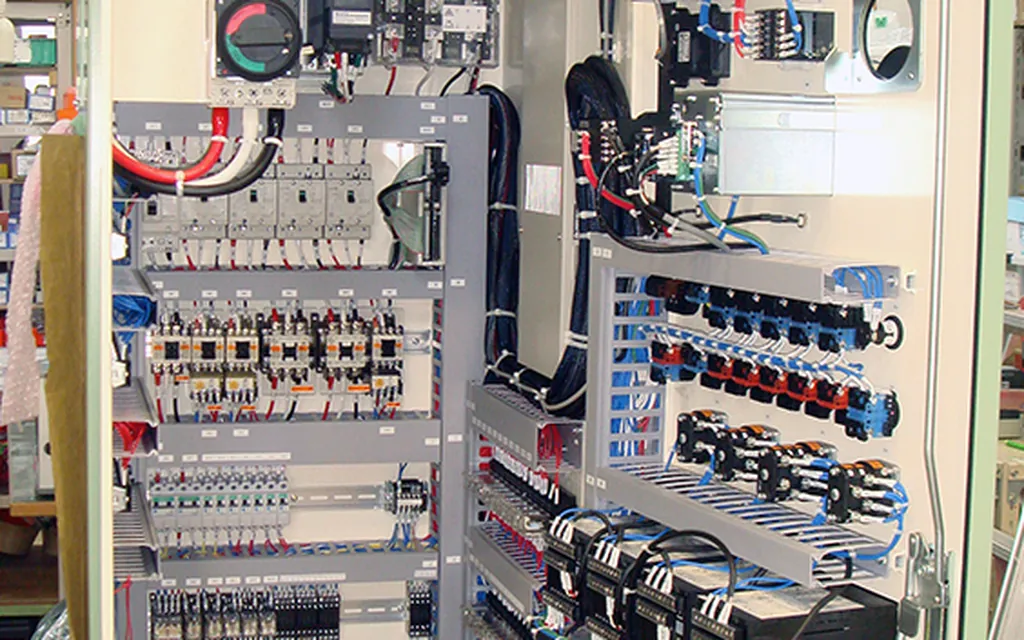
Annual electrical cabinet maintenance does not take long, but it does need a power-down window. Prepare the checklist in advance and finish within the day — do not spend the window hunting through documentation.
Shutdown sequence: load side first, then supply side; the reverse for energising. After isolation: prove dead, discharge, apply earths (on large systems), tag and lock out. Whoever isolates owns it — the key does not change hands casually.
On cabinets with multiple feeds (dual supplies, standby generators), confirm every source is isolated, control supplies included. Breaking the main circuit but leaving control power live is a classic oversight.
Capacitor cabinets deserve special care: stored energy remains after isolation. Discharge phase by phase with a discharge stick and wait long enough before touching anything. This is the step where personal injuries most often happen.
 FIELD · SCHH-2026
Clean with a vacuum and a soft brush — never compressed air (it blows dust inside components), and never a damp cloth. Cover the cabinet floor, top, component surfaces and busbar insulators.
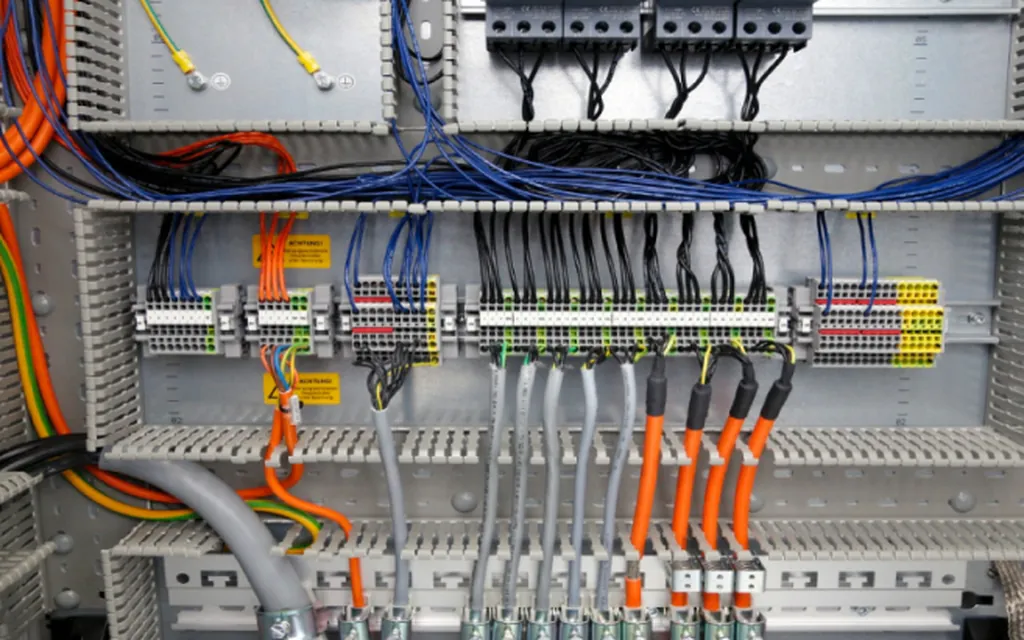
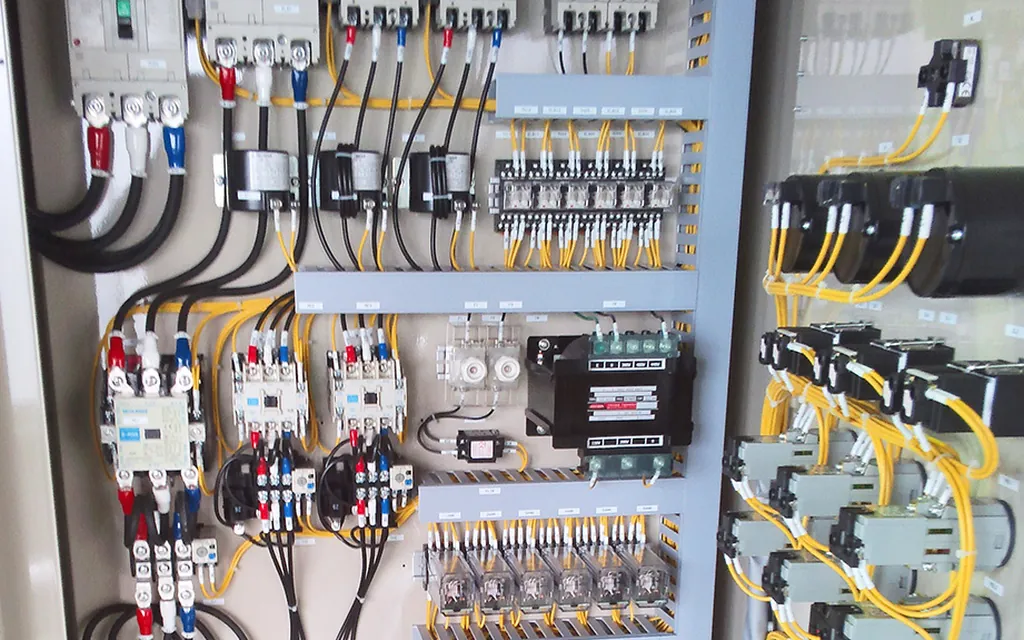
Tighten to torque standards with a marked torque screwdriver. Focus points: main-circuit busbar joints, breaker incoming and outgoing terminals, contactor main-contact connections, control transformer secondaries, and earth terminals.
After tightening, apply witness marks (a line across bolt and busbar) so the next service sees any loosening at a glance. Almost zero cost, very effective.
Check cable insulation for discolouration, hardening and damage, especially runs near heat sources. Replace faded wire markers — fault-finding later is misery without them.
 FIELD · SCHH-2026
Measurements: contact resistance at busbar joints (micro-ohmmeter, where available), breaker insulation resistance, circuit insulation resistance, and earth continuity.
Functional trials: breaker manual operation free, protection trip tests (long-time and instantaneous via a relay test set), contactors picking up and dropping out cleanly, relays operating reliably, indicator lights and instruments correct, HMI and pushbuttons all working.
Test every RCD via its test button. This should happen monthly; the annual service repeats it for confirmation.
Thermal imaging: before the annual service, scan the cabinets with an IR camera while they run normally, find the hot spots, and target those after isolation. This order beats blind searching with the power off by a wide margin.
Verify that the actual wiring matches the drawings. After years of modifications, drawings drifting from reality is common — and it is the biggest obstacle to fault-finding. Update the drawings whenever you find a mismatch, and record what changed.
Check markings: circuit numbers, device nameplates, warning labels and voltage-class labels complete and legible. Replace what is missing.
Review the spares list: common fuses, indicator lights, pushbuttons, relays and contactor main contacts — is there stock? The annual service is the moment to fill the gaps.
| Maintenance item | Interval | Method | Acceptance criteria |
|---|---|---|---|
| Thermal pre-scan (live) | 1 day before the service | IR camera across the whole cabinet | Locate abnormal hot spots |
| Isolation and safety lockout | Service day | Isolate, prove dead, discharge, tag and lock | Confirm all supplies isolated |
| Cleaning and tightening | Annual | Vacuum + soft brush; torque tightening | Dust-free; torque to spec with witness marks |
| Insulation resistance measurement | Annual | 500 V / 1000 V megger | Meets procedure requirements |
| Protection functional tests | Annual | Trip tests with a relay test set | Long-time and instantaneous trips accurate |
| RCD test | Monthly / verified annually | Press the test button | Trips reliably |
| Drawing and marking verification | Annual | Actual wiring vs drawings | Matched; update on any mismatch |
Annual cabinet maintenance is usually completed within a single production shutdown window. An eight-to-ten-hour window must cover five work groups - cleaning, inspection, tightening, testing and backup - and scheduling plus crew division decides success or failure. Suggested time allocation: three to four hours in the morning for power-down isolation, cleaning, visual inspection and tightening; three to four hours in the afternoon for electrical tests (insulation, grounding, protection verification, infrared re-scan), parameter backup and anomaly treatment; one to two hours left for re-energization trial runs, acceptance signatures and record archiving. Cleaning comes before testing, for the reason given earlier - dust hides problems, and only clean-then-inspect reveals them.
Divide the crews by discipline: mechanical and cleaning work (blow-down, tightening, sealing) by fitters with electricians assisting; electrical testing (insulation, grounding, protection verification) by licensed electricians or professional test personnel; program and parameter backup by someone who understands control systems (this item cannot be delegated to a general electrician - an incomplete backup is no backup). The three roles can work in parallel, but stagger them in space - never two crews inside the same cabinet at once, to prevent accidental contact and cross-interference.
Safety isolation is the step that cannot be compressed: power-off, verification of dead condition, lockout/tagout, grounding (high-voltage or large-capacity systems), and stored-energy release (drive capacitors require the specified discharge wait). These steps consume time but cannot be skipped. In maintenance accident statistics, "I thought it was de-energized" is the most frequent cause. Isolation measures must be confirmed and signed by a designated person - not a private glance by each worker.
The two have different jobs and do not overlap. Daily inspection is condition monitoring while running: temperature, noise, alarms, indicator lights - a ten-minute task, high frequency, few items, aimed at catching sudden anomalies. Annual maintenance is deep work with the equipment stopped: internal cleaning, tightening, testing, backup - power-off required, comprehensive in items, low in frequency. The connection point is data: trend anomalies found in daily inspection (one cabinet's temperature climbing month by month) become focus items in the annual maintenance; annual test results (insulation values, ground resistance) become next year's comparison baseline. Both draw on the same equipment file, so the data never breaks.
 FIELD · SCHH-2026
Split by capability and risk: external cleaning, visual inspection and routine tightening stay with your own crews (low cost, familiar with the equipment); electrical testing (insulation, grounding, protection verification), control-system backup and verification, and anomaly diagnosis go to a contractor or qualified personnel (instruments, credentials and professional judgment required). The most common model for annual maintenance is joint execution: the contractor provides the technical lead and testing capability while your crews supply the working hands and learn alongside - after one annual inspection, the crews' capability visibly improves. Write the interfaces into the plan: who performs which item, who accepts which item - responsibilities clear.
The design goal of a maintenance record sheet is: "next year, holding this year's sheet, changes should be visible at a glance." To achieve that, the form must have value fields, not just checkboxes: insulation resistance filled in megohms, ground resistance in ohms, cabinet temperature as measured, tightening torque as set. A tick-only form cannot form a trend - next year you will know it was "checked", but not whether it is better or worse than last year.
One record page per cabinet, headed with cabinet number, location, last maintenance date and a summary of last time's data - so that filling this year's form immediately shows last year's values and abnormal changes are caught on the spot. Anomalies go on a separate rectification list: problem description, location, recommended action, responsible position, deadline, verifier. The rectification list is not part of the record but the starting point of action - when maintenance ends, the list must be closed out.
We recommend dual-track archiving: signed paper originals on file for reference (anything touching safety and responsibility must carry signatures), and an electronic copy in the register for retrieval and trend analysis. Standardize the electronic fields well and they can be imported directly into an equipment management system later, with no rework. That is why we insist on field standards in our system deliveries - standardize once, benefit for years.
 FIELD · SCHH-2026
This article was written in-house by the Industrial Equipment Services Division. The thresholds, intervals and scrap criteria are field-experience values; in practice follow the equipment manufacturer's technical documents, current national standards and special-equipment safety regulations. Inspection and testing of special equipment (cranes, pressure vessels, etc.) must be carried out by a qualified body.
Send us your equipment list and operating conditions, and we will give you a workable inspection and maintenance standard.
 Scan to add Engineer Man on WeChat
 Guangzhou Yujihang Computer Technology Co., Ltd. · www.accpc.com.cn
 Guangzhou Henghuan Technology Co., Ltd. · www.hhrobotics.cn
 Nanchong Henghuan Robotics Co., Ltd. · www.hhrobots.cn