Crane electrics differ from ordinary plant: heavy vibration, frequent start-stop duty and energy regeneration. Those features set the care priorities — fastenings, conductor rails, braking resistors and protection functions.
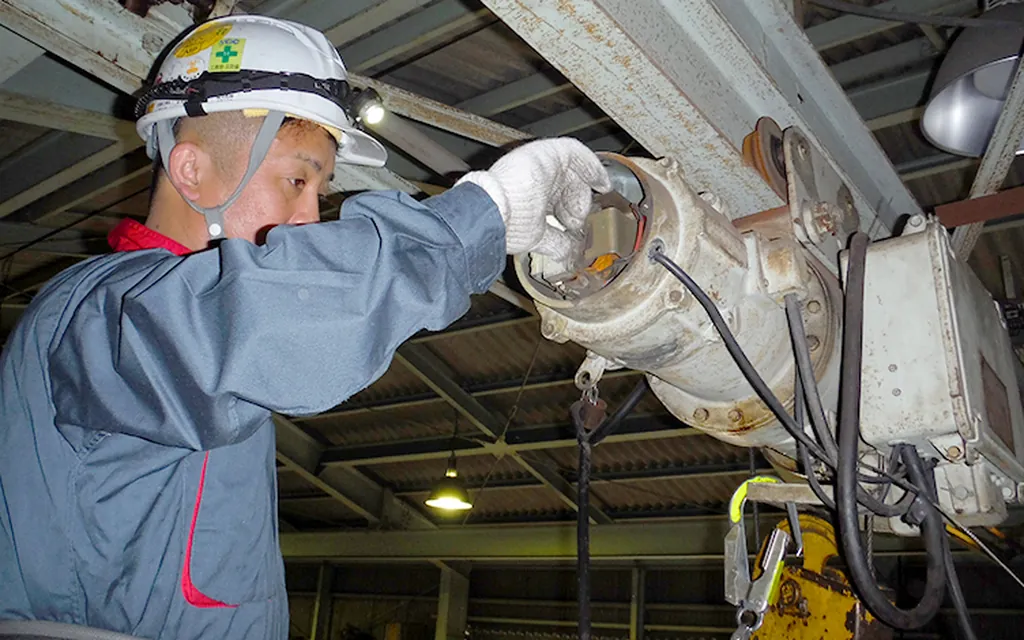
A crane vibrates continuously in operation, so every electrical connection loosens more readily than on fixed equipment. Shorten the terminal tightening interval to quarterly, focusing on bridge conductor connections, motor terminal boxes and control-cabinet main-circuit terminals.
Check cables for vibration-chafed insulation, especially at conduit entries, bends and festoon cables (drum cables, drag-chain cables). Festoon cables are a crane wear item — look for kinks, bulges and cracked outer sheaths.
Cable drums and drag chains must guide correctly. A drum paying out and reeling up out of sync loads the cable until the cores snap; cables in a drag chain must keep the specified bend radius and slack.
Terminal-box seals must be intact. In dusty shops and on outdoor cranes, water and dust getting into a box cause earth faults and short circuits.
 FIELD · SCHH-2026
Check the conductor bars (enclosed or bare) for straightness, for flush joints, and for oxidation or burn points. An uneven joint makes the collector arc, throwing sparks — damaging the equipment and a fire hazard.
Replace collectors (carbon brushes) at the wear limit mark. Insufficient spring pressure causes poor contact, arcing and phase-loss running. A motor running on lost phase burns out fast — especially common on cranes.
Check conductor-bar insulators and support brackets; a loose bracket lets the bar distort, which in turn worsens arcing.
On outdoor cranes check the conductor bars for standing water, ice and heavy rust — all of these affect conduction and insulation.
 FIELD · SCHH-2026
When a VFD hoist lowers a load, the motor regenerates, feeding energy back to the DC bus where the braking resistor dissipates it. Resistor cooling is critical — it runs hot itself, and in a poorly ventilated spot it overheats easily, tripping protection or burning out.
Inspect braking resistors regularly: element deformation or breakage, insulation decline, overheated or discoloured terminals, blocked cooling paths. Confirm the fan runs where one is fitted.
Braking-unit faults have a classic signature: over-voltage trips when lowering loads, or runaway lowering speed. On seeing these, check the braking resistor and unit first — do not blindly adjust parameters.
Care for the drive itself follows the general VFD requirements: filters, cooling, fan life, parameter backups. Crane duty vibrates heavily, so pay extra attention to drive mounting fastenings and cable fixing.
Confirm item by item: overcurrent, overload, short-circuit, phase-loss, undervoltage and zero-position protection. Zero-position protection matters greatly — if power comes on with the controller off zero, the motion starts suddenly; this protection guards against operator error.
Test the emergency stop before every shift — both the cab e-stop and the ground-control (remote or pendant) e-stop.
Check the radio remote (ground control): buttons not sticking, housing not damaged, battery compartment sound, e-stop mushroom head reliable. On radio-controlled cranes also confirm exclusive control (only one remote live at a time).
Interlock trial: with no load, run through each motion's operation, limits, braking and protection to confirm the logic is correct. This is mandatory after maintenance — never go straight to load.
| Maintenance item | Interval | Method | Acceptance criteria |
|---|---|---|---|
| Pre-shift e-stop and limit test | Every shift | Test every protection function unloaded | All operate reliably |
| Terminal tightening | Quarterly | Torque screwdriver; focus on main circuit | No looseness, no discolouration |
| Festoon cable inspection | Monthly | Drum and drag-chain cable sheaths | No kinks, bulges or cracks |
| Conductor bar and collector check | Monthly | Straightness, joints, brush wear, spring pressure | No arcing; brushes short of the limit |
| Braking resistor check | Quarterly | Element, insulation, terminals, cooling | No deformation or breakage; no heat discolouration |
| VFD filter and cooling | Monthly / quarterly | Clean filters; confirm fans | Filters clear, fans normal |
| Protection function interlock trial | Every 6 months / after maintenance | Run all logic unloaded | Logic correct, protection effective |
| Terminal-box seal check | Quarterly | Seals, cable entries | No water or dust ingress |
Most newly installed cranes are VFD driven. Compared with conventional contactor-and-rotor-resistance control, a VFD drive is clearly better at speed control, shock limitation and energy saving - but the maintenance requirements change with it. The first difference is environmental sensitivity: an inverter tolerates dust, moisture and temperature far worse than a contactor, so air conditioning and sealing of the electrical room, plus cabinet filtration and cooling, become mandatory check items. On a conventional crane most electrical faults are burnt contacts; on a VFD crane most are modules damaged by overheating and dust - the maintenance focus shifts from 'checking contacts' to 'managing the environment'.
The second difference is the importance of parameters: ramp times, torque boost, brake control logic, and overspeed and overload protection settings on the inverter all bear directly on the safe operation of the crane. Brake control is especially critical - on an inverter-driven hoist the opening and closing timing of the holding brake must be matched to the inverter output; wrong timing causes load slip (a serious safety incident) or accelerated brake wear. Parameter changes need approval and records, brake timing adjustment must be done by someone who understands it, and after adjustment both no-load and loaded verification are required.
The third difference is diagnostics: the inverter keeps fault records and running data, so after a trip the first step is reading the fault code and the history, which points straight at the direction (overcurrent, overvoltage, overheating, earth fault, communication) - much faster than point-by-point tracing on conventional control. This requires maintenance staff who can read fault codes and retrieve records, and it requires the parameter and fault-code reference tables to be filed with the equipment dossier - without the tables a fault code is just a string of numbers.
Yes. The overload limiter is the key safety device against overloading accidents, and its accuracy drifts with sensor drift, mechanism wear and loose mounting. Calibration intervals are set by regulation and duty intensity - normally at least once a year, more often under heavy use. The method is applying a known weight (standard test weights or a metrologically verified mass) and checking the displayed value against the trip values: both the alarm point and the cut-off point must fall within the specified error band. Keep calibration records on file, matched to the statutory inspection reports. Plants without calibration facilities can commission a professional body, or use the plant's own calibrated instruments with verification. One warning: an overload limiter deliberately bypassed or shorted out is a major safety hazard - inspection must confirm the device is in effective working order, and this point admits no compromise.
 FIELD · SCHH-2026
It depends on the equipment condition and the need. A VFD conversion normally brings four benefits: better speed control (smooth starting and braking, less mechanical shock and structural fatigue - of great value for precision lifting), energy saving (conventional rotor-resistance speed control dumps large amounts of energy in the resistors, and a VFD has no such loss), longer mechanical life (less shock means less wear on the wire rope, brakes and gearbox), and a change in maintenance mode (contact-related work drops, though inverter maintenance is added). To judge whether it pays, look first at the problems with the existing equipment: high shock loads, tight positioning requirements, frequent resistor box failures and high energy consumption all point to clear gains. Where the equipment is old and the structure is in poor condition, the structural assessment must be done together with it - an electrical retrofit alone may not pay off. Our approach is a condition assessment plus needs analysis first, then benefits against investment, then a recommendation. We do not retrofit for the sake of retrofitting.
Earthing is the basis of crane electrical safety: the metal structure, equipment enclosures and cable metal sheaths must all be reliably earthed, and earth resistance must be measured periodically against the specified limit. A crane runs along rails, so its earth path goes through the rail and the wheels, and unstable contact resistance is a common problem - which is why, besides measuring total earth resistance, the bonding jumpers on the rail earth must be checked. The consequence of poor earthing is that protective devices fail to operate during an earth leakage and the metal structure becomes live - a major safety hazard.
Insulation checking has two parts: circuit insulation (main and control circuits meggered at the specified interval, more often in damp conditions) and hook insulation (for particular duties such as handling molten metal or working in electrolysis shops, the hook and rope system need insulating protection, and the condition of the insulating parts must be checked as a dedicated item). In ordinary shops insulation checking follows the annual electrical test programme, with data on file for comparison; in special duties the intervals and standards of the relevant safety code apply.
Cranes working in the open (gantry and tower cranes) need lightning protection considered: where the height exceeds the specified value or the area carries a lightning risk, install lightning protection and test earth resistance periodically. The dedicated check before thunderstorm season should cover the condition of the lightning protection, the earth path, and moisture sealing of electrical equipment. Cases of lightning destroying inverters and control systems are not rare, while the cost of lightning protection testing is small. All three of these are protections that 'look useless in normal times and become a major event when something happens' - put them in the annual inspection plan and they will not be missed.
 FIELD · SCHH-2026
This article was written in-house by the Industrial Equipment Services Division. The thresholds, intervals and scrap criteria are field-experience values; in practice follow the equipment manufacturer's technical documents, current national standards and special-equipment safety regulations. Inspection and testing of special equipment (cranes, pressure vessels, etc.) must be carried out by a qualified body.
Send us your equipment list and operating conditions, and we will give you a workable inspection and maintenance standard.
 Scan to add Engineer Man on WeChat
 Guangzhou Yujihang Computer Technology Co., Ltd. · www.accpc.com.cn
 Guangzhou Henghuan Technology Co., Ltd. · www.hhrobotics.cn
 Nanchong Henghuan Robotics Co., Ltd. · www.hhrobots.cn